
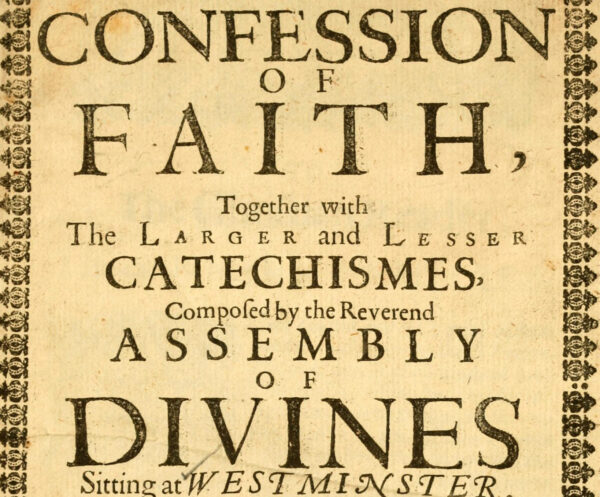
A confession of faith is a summary of biblical doctrine, written by a church or a group of churches, to publicly declare what they believe the Scriptures teach. It is not a replacement for the Bible. It is a subordinate standard—a servant of the Word, not a rival to it.
The Reformed tradition has always insisted that Scripture alone is the final authority. Confessions are valuable only insofar as they faithfully summarize and submit to Scripture. As R.C. Sproul explained, the historic confessions were “an attempt to crystallize the essence of doctrine found in sacred Scripture. They were never to be seen as a substitute for Scripture or as having authority over Scripture” .
Ligioniers: How important are creeds and confessions?
Why Confessions Mattered in the Reformation
The Reformation was not a rebellion against authority. It was a recovery of authority. When the Reformers were accused of innovation, they appealed to the early church fathers and to the ancient creeds to show that their doctrine was apostolic, not novel. But they also needed to state clearly where they stood on the contested issues of the day.
John MacArthur notes that “creeds were never formulated to invent fundamental doctrines, but rather to defend them. They are repudiations of false doctrines—condemning new error by affirming established truth” . The Augsburg Confession (1530), the Heidelberg Catechism, the Westminster Standards, and the 1689 Baptist Confession were all written in this spirit. They were not attempts to add to Scripture. They were attempts to say, with precision and clarity, what Scripture teaches on matters that were being denied or distorted.
GTY: What are the fundamentals?
GTY: Is the apostles creed all I need to belief?
The Agreement of the Early Church
Confessions did not begin in the sixteenth century. From the earliest days, the church summarized its faith in short statements. The simplest was “Jesus is Lord”—a direct challenge to the Roman loyalty oath “Caesar is Lord” . The Apostles’ Creed and the Nicene Creed were later expansions, written to defend the Trinity and the person of Christ against specific heresies.
The early church fathers were not creating new doctrine. They were defending what had been handed down. Irenaeus and Tertullian both spoke of a “rule of faith”—a summary of apostolic teaching that was entirely based on Scripture . The Reformers saw themselves as standing in that same line. They were not inventing a new faith. They were contending for the faith once for all delivered to the saints (Jude 3).
The Danger of Abandoning Confessions
When a church abandons its confession, it does not become neutral. It becomes ambiguous. And ambiguity, over time, becomes unbelief.
Albert Mohler has observed that “when a church forfeits its doctrinal convictions and then embraces ambiguity and tolerates heresy, it undermines its own credibility and embraces its own destruction” . The Church of England is a case study. It did not formally deny the gospel. It simply stopped defining what it believed with clarity, and the result has been decades of decline.
Ian Hamilton’s historical study, The Erosion of Calvinist Orthodoxy, traces the same pattern in the nineteenth and twentieth centuries. The road from confessional fidelity to theological liberalism was not a sudden leap. It was a slow drift, made possible by the gradual abandonment of the doctrines the confessions had guarded.
The Basic Choice: Submission or Rebellion
At the heart of the matter is a single question: does the church submit to God’s Word, or does it sit in judgment over it?
A church that abandons its confession is not merely changing its mind about a few secondary matters. It is making a statement about authority. It is saying, in effect, that the church—not Scripture—has the final say on what is true. This is the same rebellion that began in the garden: “Did God really say?” (Genesis 3:1).
The Reformers understood that the church is not the master of the Word but its servant. A confession is an act of submission. It says, “This is what we believe Scripture teaches, and we bind ourselves to it.”
The Fruit of Abandonment
Churches that abandon the core beliefs of the confessions do not simply become “more open” or “more loving.” They fall into ancient errors, dressed in modern clothing. The liberalism of the nineteenth and twentieth centuries was a revival of old heresies—a denial of the supernatural, a confidence in human reason, a rejection of the atonement. What we now call the “woke church” is another form of the same drift: a substitution of cultural ideology for biblical authority. The sects—Jehovah’s Witnesses, Islam, and others—are not new inventions. They are old errors, repackaged.
The confession is a wall. It does not keep people out. It keeps error out. When the wall is removed, the church is not safer. It is more vulnerable.
Why Confessions Still Matter
A good confession does two things. It clarifies what the church believes, and it shows why. The great confessions do not simply state a doctrine. They list the Scripture references that support it. This is a crucial point. The confession points beyond itself to the Word of God. It says, in effect: “Do not take our word for it. Read the Bible. This is what we believe it teaches.”
This is why a confession is not a tool of control. It is a tool of clarity. It helps the church teach, defend, and pass on the faith. It helps believers recognize error when they hear it. And it helps the church remain faithful to the Word of God, which is the only infallible rule of faith and practice.
As the 1689 Baptist Confession opens: “The Holy Scripture is the only sufficient, certain, and infallible rule of all saving knowledge, faith, and obedience.” Everything else—including the confession itself—stands under that Word.